

An underground water leak isn’t always easy to spot. It can drain treated water for months before it’s noticed or reaches the surface. Often, the first clues show up in system data as a longer pump runtime or an unexplained audit gap. These losses carry costs that reach beyond the balance sheet. Finding and repairing those leaks quickly protects both infrastructure investments and the surrounding environment, and today’s approach combines field experience with acoustic monitoring, correlation, and final pinpointing tools that listen more consistently than manual methods alone.
Utilities loseclose to 19.5% of their treated water before it ever reaches a customer, worth more than $6.4 billion in lost revenue annually, and distribution systems across the United States now need $625 billion in new infrastructure investment over the next 20 years, including $422.9 billion for distribution and transmission infrastructure alone, a gap reflected in the C- grade U.S. drinking water infrastructure recently earned.
The environmental toll extends beyond the numbers. Undetected leaks allow chlorinated water to seep into soil and waterways, where it can harm aquatic ecosystems. That chlorine moves from streams into rivers and eventually into oceans, disrupting habitats and threatening fish populations along the way.
Crews can find leaks by walking routes and listening in the field. The challenge is that a leak has to be loud enough to notice during that pass. Acoustic detection technology helps fill in the gaps by listening more consistently across the system.
Several operational signals can help utilities detect an underground water leak before it becomes a costly repair. Watch for these key indicators in your system’s day-to-day data:
These signals point to a problem, but confirming the leak’s location requires a dedicated detection process.
Underground water leak detection rarely happens in one step. It usually starts with continuous monitoring, moves into precise correlation and ends with final pinpointing. While pressure management tools like the Pegasus 2 help prevent leaks from developing in the first place, detecting and locating existing leaks requires a layered acoustic approach. Understanding that process starts with knowing where manual methods leave off.
Utilities often send crews out to walk pipe routes with listening rods. They listen for escaping water and look for signs at the surface, like wet pavement or soft ground. The process may be familiar, but it still takes experience.
A single pass over a pipe route can only cover so much ground, and a small, slow leak can run undetected for months or years before it grows loud or visible enough to catch someone’s attention. By then, the eventual repair is often more extensive and more expensive than it needed to be.
Acoustic data loggers like the PermaNET SU and Permalog+ remain in the field to continuously monitor your distribution network. While the PermaNET SU delivers real-time alerts and analytics when it detects a potential issue, the Permalog+ requires a utility to drive over the logger and gather the data. The loggers flag zones of concern automatically, giving crews a clearer starting point before they leave their utility.
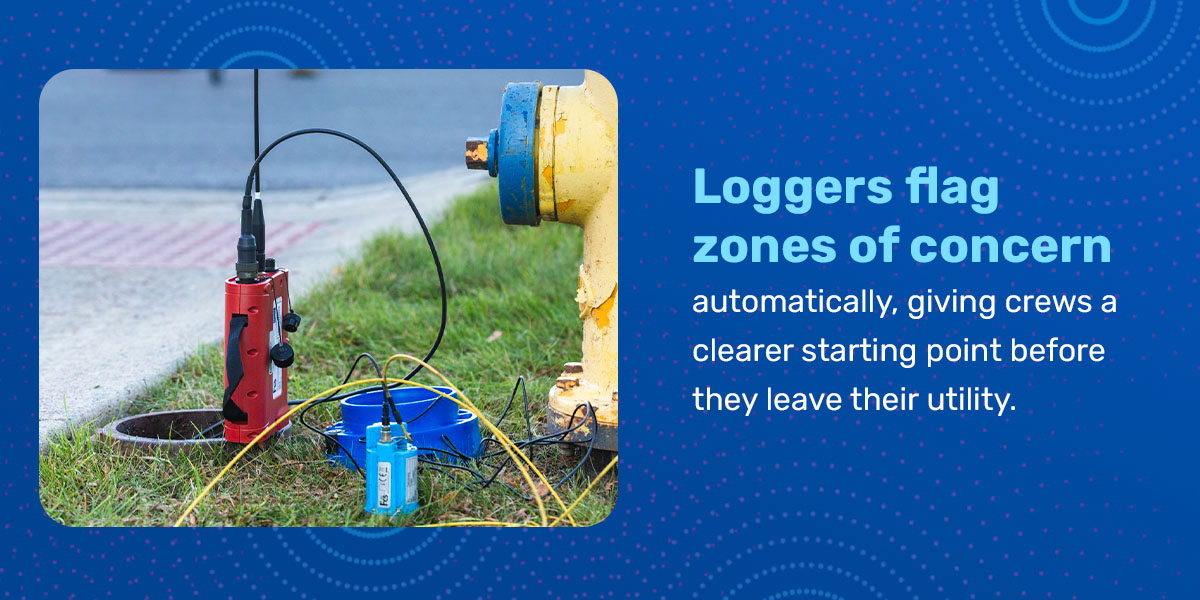 More than 32,000 of these American-made, award-winning sensors monitor over 7,000 miles of U.S. drinking water systems, forming the first line of acoustic water leak detection that helps preserve aging infrastructure in municipalities across the country.
Detecting an underground water leak requires more than identifying a general area of concern. Once a logger hears a possible leak, the crew still has to narrow down the location. A leak correlator like the Tri-Corr Touch Pro helps with that step. The technician places two sensors on the pipe, usually at hydrants or fittings on both sides of the suspected area. The correlator listens for the leak sound at each sensor and compares the timing to estimate the leak’s location.
Fluid Conservation Systems (FCS) invented the leak correlator more than 40 years ago, and the Tri-Corr Touch Pro represents decades of refinement in that original technology. The Tri-Corr Touch Pro’s Automated Filtering Intelligence System runs up to 55 filter combinations automatically, testing and refining results without requiring an operator to configure anything manually, and it performs reliably across pipe types, including plastic and large-diameter pipes that have challenged leak correlators, which deliver unmatched accuracy within 0.1 feet. A correlator identifies a noise that could be a leak, rather than confirming one outright, which is why the next step still matters.
With the search narrowed to a specific section of pipe, ground microphones help confirm the precise dig point as a technician walks the surface above the waterline, listening for the loudest point along the stretch.
Different crews need different tools in the field, so FCS offers ground microphones for a range of experience levels and daily use cases:
Once that dig point is confirmed, the crew can excavate with confidence, turning what started as an invisible loss somewhere in the network into a single, precise repair.
When water utilities compare leak detection partners, a handful of factors tend to separate a reliable, lasting choice from a short-lived one. Here’s what sets us apart:
These factors matter, but for many utilities, cost is still the first question.
The PermaNET SU qualifies for funding under the Environmental Protection Agency’s Drinking Water State Revolving Fund and the Build America Buy America Act, meaning a logger purchase may be eligible for federal and state funding support, depending on the project, state program and funding requirements. For utilities operating with limited capital budgets, that eligibility may make it easier to plan a monitoring upgrade that helps preserve aging infrastructure.
For utilities that want to see the technology in action before committing further, the Leak Detection Pilot Program offers a low-cost way to trial the system firsthand, with a minimal up-front investment. Between funding eligibility and pilot access, this technology tends to be more within reach than many utilities initially assume.
Manual fieldwork will always have a place in protecting your water system, but your crews need reliable data to find hidden leaks faster. Fluid Conservation Systems offers a complete acoustic detection system for exactly this challenge, from loggers that monitor your network day and night to correlators and ground microphones that pinpoint the exact spot worth digging.
We’ve spent more than four decades refining this process alongside utilities like yours. When you’re ready to see it in action, request a quote or explore our Leak Detection Pilot Program for a low-cost trial. Have questions first? Our team is happy to talk it through, so feel free to contact us.

